Photo Trekking 5: Cedarville State Forest
[This is my 5th installment in a 6-part series for a photo trekking class I took with Barbara Southworth through the Smithsonian Associates Residence Program.]
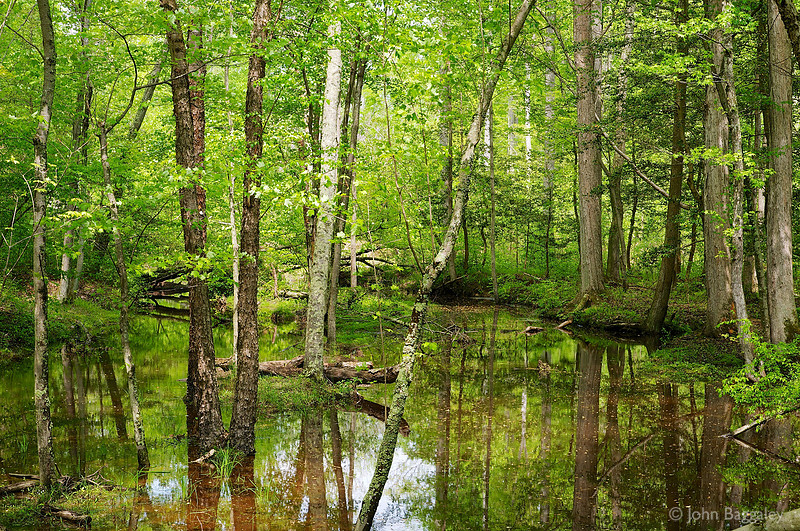
Cedarville is a forest with some swamps and bogs. Because it had just rained, everything was lush and green. All of the leaves were dripping with the rain.  
After what must have been an hour of hiking and shooting . . . and mostly shooting . . . I think we only traveled perhaps 100 yards. Barbara laughed that we were the easily amused group. 
There was a lot to see in the swamp. I almost missed this frog: 
I particularly liked the swamp. For a short while there was a mist rising from the water. I tried to capture what I saw in the following: 
The light kept changing quickly. The following photos were taken only moments apart: 
I love the color green and I like water. I really liked this ivy covered bridge. Could we fit more green in a single picture? 
Cedarville might have been my favorite hike so far. I really enjoyed it. Photo Trekking 4: Carderock[This is my 4th installment in a 6-part series for a photo trekking class I took with Barbara Southworth through the Smithsonian Associates Residence Program.]
On the 18th, my photo trekking class went to Carderock in Great Falls National Park, Maryland. The previous weekend, we visited Great Falls in the early morning. For the trek on the 18th, we went hiking in the late afternoon and evening to see how things would look with sunset lighting.
The light wasn’t much better later on either. We didn’t get a sunset because a blanket of clouds rolled in and blocked out the sun. However, not all was lost. Things worked out a bit better in the shade and with some selectivity, I could get nice shots. I really like the following turtle photo and the photo of the turtle at the top of the page.
I wasn’t inspired to take any landscape photos this trip. So, I put away my wide-angle lens and pulled out my Nikon 70-300 VR telephoto lens. I used the telephoto to zoom in on details. I really like how the light falls on the leaves and flowers in the following:
There were a lot of purple phlox in bloom:
I’m not a flower expert, so I don’t know what this is, but I love the yellow set against the dark green: It was a beautiful hike. There were flowers in bloom everywhere I looked. The most exciting moment of the hike, for me, was this dragonfly that I photographed at the end of the trail. It was a very challenging shot to take. To get the shot, I used my Nikon 70-300 VR lens at 300mm on a tripod. I stood as close to the dragonfly as I could get. (The lens has a minimum focus distance of 5 feet.) Then, to get the entire dragonfly in focus, I stopped down the lens to f/16. For metering, I selected spot metering. Photo Trekking 3: Great Falls AM
[This is my 3rd installment in a 6-part series for a photo trekking class I took with Barbara Southworth through the Smithsonian Associates Residence Program.]
Last weekend I went to Great Falls for my photo trekking class. While I had been to Great Falls before in the summer and in the winter on the Virginia side, this was my first time visiting the Maryland side. We started off by hiking up a ridge. I found an opening in the trees and was greeted with a beautiful view of the other side of the river. The morning light was magical. Much of the hike at first was in the shade. So, I focused on lines and perspective. Then, I ventured off the path and into the woods. I really like the morning light coming through the canopy of leaves. 
This one feels almost religious to me. I set the white balance using a gray card--about 9600K. The yellow is actually pretty accurate. 
Having only been on the Virginia side of the river, I completely missed the C&O canal. The still water in the canal created a mirror-like reflection of the trees. I loved it. I took this image from down low at 16mm with my camera aimed a bit downwards. 
Later we went to some of the smaller waterfalls. It was really bright. Even stopped down and with a polarizer, I could not get a slow shutter speed. However, it may have worked out better this way. I like the water in the bottom right of the frame. 
After the waterfalls, we hiked the Billy Goat A trail. It’s a fun hike. Almost the entire hike is a rock scramble. Every year, dozens of people fall. I hope you can tell from the photo why. 
As it turns out, someone did get hurt while I was on the trail. We ran into a few members of the fire department who were carrying medical gear. They were searching for a fallen woman. Not long after, a Park Police helicopter showed up. It came down above the ridge line and came very close to me. I was able to take these photos with a mere 85mm lens. 
I was glad to hear from another hiker that they found the woman. It sounded like she broke her leg or something but would otherwise be okay. 
DC Cherry Blossoms 2010
Last weekend was the peak for cherry blossoms around the Tidal Basin. On Sunday, I road my bike to the Tidal Basin to photograph the blossoms as the sun rose. I did the same thing last year. Last year, I took a lot of photos of the Tidal Basin ringed by cherry trees in bloom. While the Tidal Basin itself is an obvious subject, it’s actually a bit hard to get interesting photos of the Tidal Basin. It can actually be hard to see the blossoms when you focus on the water because the blossoms are so small and at a distance lack definition. I tried to do a bit of the same this year but with some added creativity:
The photos I really liked the most last year focused more on the trees than the Tidal Basin. Here’s one with of a tree catching some of the morning light hanging over the water.
But this year, I made an extra effort to focus on the blossoms themselves. I think the bokeh (pleasing out of focus background) on this one is really nice.
Another thing I tried was turning around and looking away from the tidal basin. I found a pleasing canopy of cherry blossoms:
Pointing my camera up also gave me some fun results:
One added benefit of focusing on details is that you can avoid the crowds--and there are big crowds at the Tidal Basin for the National Cherry Blossom Festival--though it also helps to go really early in the morning as I did.
Sometimes it’s nice to get people in the photo. In this one, the presence of the girl in orange make things feel very relaxed and serene, but I could do without that photographer way off in the background.
I walked all around the Tidal Basin and came to the Thomas Jefferson Memorial. While not a photo of cherry blossoms, I could not resist taking this photo:
The columns right outside struck me as particularly interesting. I tried playing with the shadows that they created and some depth of field. Notice how the columns look like they are different widths?
Photo Trekking 2: Catoctin
[This is my 2nd installment in a 6-part series for a photo trekking class I took with Barbara Southworth through the Smithsonian Associates Residence Program.]
On Sunday, I went to Catoctin Mountain Park with my Photo Trekking class. It seems we used up all of our good weather last weekend at St. Mary’s Watershed. Sunday was cold and dreary with a forecast for rain. The following picture of Chimney Rock isn’t very nice, but I think it conveys the dreariness:
Even though it was early morning, when the light is normally really good, the clouds made the light flat and boring. Spring hadn’t hit Catoctin yet either, so we missed the greenery. No greenery and bad lighting made for quite a challenge. But the challenge wasn’t unsurmountable. If you look carefully, there’s lots of color to be had, just not the colors you might expect. In the following photo, also taken at Chimney Rock, you can see lots of reds and browns. I cut out the sky because it would be bright, boring, and overwhelming. Instead, I focused on texture and depth of field. The rocks share some color with the trees.
I tried to take the opportunity to play with composition. I really like the following photo, but it could have been better. I was too lazy to use my tripod on this one, which I now really regret. To get the image sharp without a tripod, I needed a fast shutter speed. Unfortunately, I needed to use a small aperture in order to obtain good depth of field--getting both ends of the tree in focus. This meant I had to use a high ISO setting, which reduced the dynamic range I was able to capture with my camera.
I also took the following photo hand-held. I don’t think this one was hurt quite as much by the higher ISO setting. I like the three dimensional look created by different layers of trees in the foreground and background. I also like the squiggly lines. Including just a bit of sky seemed to add interest and make the image look less flat.
After hiking around for a bit, we went to Cunningham Falls. I really like waterfalls, like just about everyone, so I was excited to go to the tallest waterfall in the Washington, DC, area. Cunningham Falls has a viewing area on which people can stand and watch the falls. Unfortunately, there are trees and such that obstruct the view a bit. To get a good shot of the falls, I had to climb the railing and get closer. I’m glad that I did. I like this image:
Here’s another one taken from even closer. I tried to frame the image so that the water would flow from the top-right corner to the bottom-left corner, thereby creating movement and interest. To get the silkiness of the water, I stopped down the aperture and used a polarizer to get a slow shutter speed.
At the end of the hike, I walked with the instructor, Barbara Southworth. As we walked, I thought mostly of going home. All the trees looked the same to me. However, it was clear that things looked different to Ms. Southworth. She pointed out a small beech tree and said she’d like to take a picture of it. I hadn’t even noticed the tree, but as soon as she pointed it out, I knew immediately why she wanted to take a photo of it. The small beech tree stood all alone, surrounded by much taller trees. The beech tree had bright golden white leaves that stood out in stark contrast from its surroundings. Behind the beech tree was a moss covered log with mushrooms growing on it and further back was a huge vine growing up a tall tree. We stopped to take the photo and here is what I got:
positioned the tree in the frame 1/3 from the right. I like the end of the fallen tree behind it, so I positioned it 1/3 from the left. A diagonal log in the foreground gives an impression of movement. For the background, I was careful not to get any sky in the photo. I think my photo turned out nicely, but you can barely see the vine snaking up the tree behind the beech tree. In a sense, my photo really is lacking because the vine is wasted and almost distracting. This was most obvious when I saw how Barbara framed her photo. In the following photo, the vine is barely visible behind and to the left of the beech tree. (In this photo, I’m standing a bit to the left from where I stood in the previous photo.) Imagine how the photo would look if I had stood even further to the left. Barbara was able to frame the photo so that the vine snaking up the tree was exactly 1/3 from the left of the frame, while the beech tree was exactly 1/3 from the right of the frame. This made the image of the vine and the beech tree very distinct from each other and gave her photo a wonderful sense of balance.
As I progress as a photographer, I’m becoming more and more comfortable with the workings of my camera and the technicalities of photographer. I’m also becoming more and more aware of the importance of composition. |