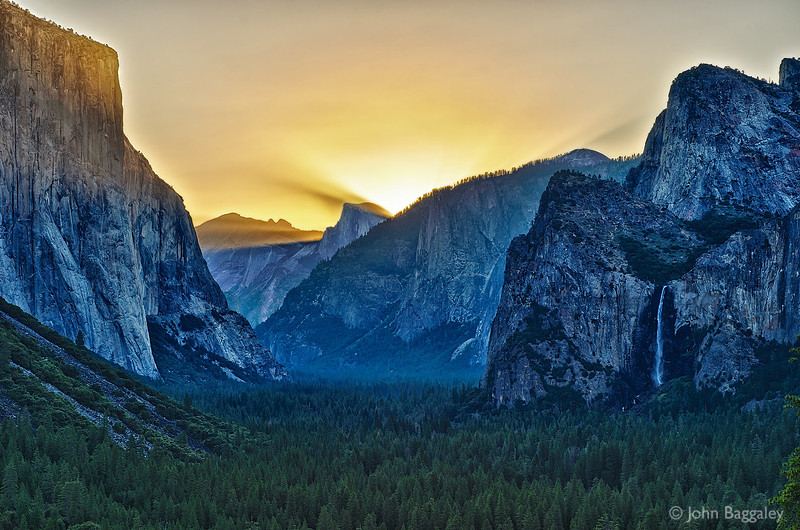
Sunrise over Yosemite ValleyI recently returned from a short vacation in California with my wife where we visited Yosemite. We had a great time and I got some great photos. My wife was very patient with my photography and I'm very grateful to her for that. Above is one of my favorite photos from the trip. The view of Yosemite Valley from Tunnel View is probably one of the most photographed images of Yosemite. It's a beautiful vista and it's hard to take a bad photo from that location. However, it's also deceptively hard to take a good photo. One of the things that I've discovered about landscape photography is that skies are very frequently boring. A sure way to ruin a beautiful landscape photo is to fill it with solid blue sky. When the sky is solid blue, my usual solution is to frame the photo without any sky. However, this solution doesn't work with something like Yosemite Valley because much of the interest comes from the peaks surrounding the valley, and you can't capture the peaks without capturing some sky. We were cursed with clear blue skies for most of our trip to Yosemite, so I had to get creative. In the shot above, you can see that I used the sun to create interest in the sky. When the sun rose just behind Half Dome, it shot of rays of light all over the rim of the valley. The rays of light add interest to an otherwise boring sky. I really like the effect. Over the next few weeks, I'll share some more of my favorite photos. I'm still processing many of them. Cambridge meets Boston
For the long July 4 weekend, my wife and I made the trip up to Boston to visit my sister and see all my old stomping grounds. It was fun to see MIT again and roam around the Back Bay.
I spent 7 years in Boston. It's one of my favorites cities. I love that it's not too big, but it still has everything you expect in a big city. You can walk almost everywhere and still visit great parks and restaurants. It's also very clean and has lots of trees. It's a very picturesque city. I brought my camera with me for the visit. Since photography wasn't my primary reason for visiting Boston, I didn't bring my tripod. Nevertheless, I wanted to return to DC with some good pictures of Boston. This one, I think, turned out nicely. It's a panorama of the Charles River from the vantage point of the Harvard Bridge (MIT and Cambridge are on the left, Boston is on the right, and most of the sailboats are MIT dinghies). I spent 4 years walking across this bridge every day. I love the view. I would have liked to spend a lot of time carefully crafting this photo; perhaps taking it during a sunrise or a sunset. However, I didn't want to bore my wife and my sister or make them get up too early in the morning—they were already being very patient with me as it is. So, while the photo isn't anything special artistically, it works for me, as it evokes some really wonderful memories. It's a very fine postcard shot.
18x3 high dynamic range images; 46.5 MP, 50 mm, f/8; blended with Nik HDR Efex Pro, stitched with Hugin, and retouched with Apple Aperture. Panoramas of Washington National CathedralLately, I've been interested in creating panoramas. I've been reading up on the subject and found a wonderful open source application called "Hugin" that can be used to create panoramas by stitching together photos. The latest release is quite powerful and despite the fact that it's free software, it's quite polished. To test out the latest release of Hugin, I visited Washington National Cathedral. I've always loved cathedrals and the National Cathedral in particular. I also recently finished reading Ken Follett's great book The Pillars of the Earth, which has me even more excited about cathedrals. So, the National Cathedral was a perfect subject for my test. My goal was to take a 360 degree panorama of the interior of the cathedral from the crossing (the point in a cathedral where the nave, transepts, and presbytery intersect). I think it worked: To take this image, I placed my camera on a tripod and used a spirit level to ensure that the entire setup was perfectly level. I set the focal length to 24mm with an aperture of f/8. I took some test shots and then set my camera to full manual mode using the shutter speed taken from the test shot (to ensure even exposure across every image). Then I began shooting. After each image, I rotated the camera slightly to the right, making sure the next image would overlap with the previous image by at least 25 percent. After rotating an entire 360 degrees, I angled my camera upwards 45 degrees and repeated the process. (This took a long time because I had to wait patiently for people to move out of my shots.) Each image that I took was actually a series of 3 shots--one evenly exposed, one under exposed, and one over exposed. In total, I took 117 shots. For each set of 3 shots, I later blended them together into one high-dynamic-range (HDR) image using tone mapping software called HDR Efex Pro. I did this because the lights and windows were too bright and the shadows were too dark otherwise. The act of blending the photos toned down the lights and brought out the details in the shadows. This left me with 39 high dynamic range photos, which I stitched together in two rows using Hugin to form the image above. I think the result is quite spectacular. (The final image is massive, so I reduced the size for purposes of posting it online.) While I liked the panorama from the crossing, I had been hoping to get an image that featured the sanctuary and the altar more prominently. So, I entered the presbytery and repeated the same process, except that this time, I used a 12mm focal length (very wide) and in Hugin I used a mercator projection instead of a cylindrical projection.
 
I hope you will agree with me that my experiment was a success. I love the unique perspective that the panorama stitching software provides. However, generating the images was quite laborious. In taking the photos, I had to use manual camera settings and ensure that the the camera was perfectly level at all times. Moreover, between the two panoramas, I processed 201 images. Blending and stitching takes a lot of computer processing, so the entire process was very time consuming. However, I think it was worth it, and I look forward to more such experiments. Herons and PickerelI love bird and wildlife photos and I think they're the best when they display some context. I took this photo last weekend at Kenilworth Park and Aquatic Gardens in Washington, DC.
Photos of birds in flight can often be challenging because frequently you either end up aiming your camera up in the air and getting a photo of a bird with a boring pale blue background or you get a busy background that distracts from the image of the bird. I think I avoided both of those problems in the following image:
The herons on Sunday morning were quite active. I captured the following great blue heron just after it caught a fish.

The blur, or aesthetic quality of the blur, in a photo is called "bokeh". I think the bokeh in this image frames the pickerel nicely. While the background was actually very busy, I threw it way out of focus by using a long lens and positioning myself significantly closer to the flower than the background. Morning in Shenandoah National ParkLast weekend, I really wanted to shoot waterfalls. Some of the best waterfalls in the mid-Atlantic region are located in Shenandoah National Park. So, I got up very early and headed out west to the park. Not long after entering the park and turning down the famous Skyline Drive, I came across this vista and beautiful sunrise. I immediately pulled over and grabbed my camera and tripod.
Energized by the sunrise, I headed over to Whiteoak Canyon to shoot Upper Whiteoak Canyon Falls. The hike through Whiteoak Canyon to the upper falls was 2.3 miles downhill (4.6 miles round trip). The return trip was much more difficult because it was all uphill. However, the hike was very much worth it.
The Cedar Run trail was very beautiful, but I wasn't particularly impressed with the actual falls. Perhaps, my inspiration was waning as I got tired. 8.3 miles in one morning is a lot, particularly with significant elevation changes. A brief late morning rain shower didn't help either. However, on my return trip from the falls, I came across this surprise: 
|