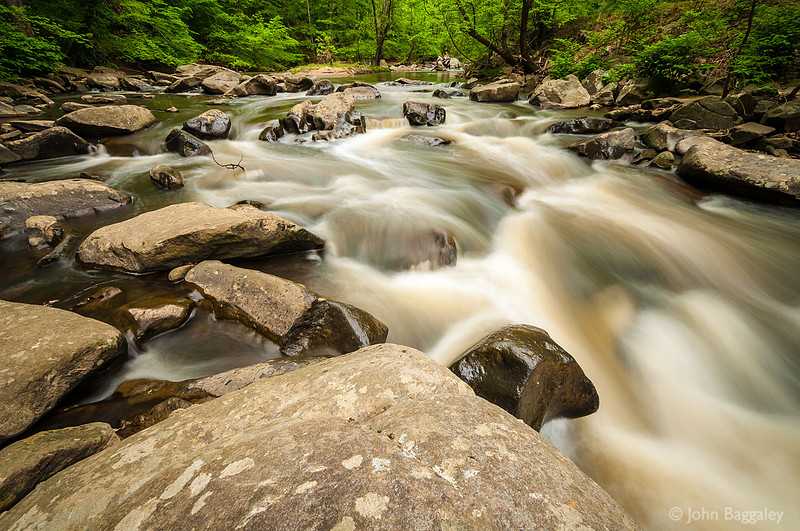
Rock CreekLast Sunday, Melissa attended a baby shower near Rock Creek Park. I gave her a ride to the shower and, despite the fact that it was a drizzling dreary day, I figured I'd use the opportunity to take a few photos of Rock Creek in Rock Creek Park.
To get the shot, I had to climb out on a number of big (and some unfortunately not so big) slippery rocks to get into the middle of the river. The blur of the water comes from using a 2.5 second shutter speed and a tripod. The slow shutter speed was made possible by my use of a 6-stop neutral density filter. The lens reduced the amount of light going through my lens by a factor of 2^6 = 64. That's really dark. In fact, it was so dark looking through the lens, I had trouble focusing the camera.
Sunday was also a good day, despite the rain, to see the azaleas, which were just starting to bloom along Rock Creek. I love the wild azaleas around Washington, DC. They're called "pinxter azaleas" or "Pinxterflowers" (Rhododendron periclymenoides). They aren't your garden variety azaleas (literally!) because the shrubs lose their leaves during the winter and most landscapers prefer a plant that retains its leaves. The species name comes from the Latin for "naked-flower", since the flowers of the plant often appear before its leaves are fully expanded.  
Trillium
I arrived just as the sun was rising. The very first rays of light streamed up my path and lit up the trillium in the following photo. The light lasted only a matter of seconds, but I think I got it just in time. I used an ultra-wide angle lens in order to get in close to the flower and capture some of the surrounding context.
I decided to take a chance at a high-dynamic-range panorama. The image consists of 15 images: 5 high-dynamic-range images stitched together using Autopano, each of which is a high-dynamic-range image consisting of 3 separate images blended together using Nik HDR Efex Pro. It took several attempts to get this final image. The wind was blowing and the movement of the clouds kept shifting the light around. I like this image for the interesting lighting, the color, and the layers created by the hills. An afternoon in Rock Creek Park
Since Congress is out of session for the Easter holiday, I was able to get off work a little early on Thursday and head over to Rock Creek Park to do some hiking and take some photos. The late afternoon sun gave me this great forest shot with the sun streaming through the leaves.

The dogwoods are in bloom here in the District and when I went to the park, I was hoping that I would see a bunch of them along Rock Creek. I would have liked to get a shot of a dogwood in bloom leaning out over some rapids. Unfortunately, I didn't find very many dogwoods. But I did find this one growing next to the creek. Since the tree wasn't actually leaning out over the water, I had to get a bit creative. To get the shot, I stood up very high on top of Boulder Bridge and use a telephoto lens. I think it turned out nicely. The setting sun provided some nice accents to the flowers and leaves. 
While I was there, I also took a photo of Boulder Bridge. It is one of the most iconic structures in Rock Creek Park. (I'll definitely have to try this one again in the fall.) 
When I took this photo, the highlights in the trees were too bright and all washed out. Likewise, the shadows around the bridge were too dark. So, I took three photos, one with the trees exposed correctly, but everything else too dark, one with the shadows exposed correctly, but everything else too bright, and one balance in between. Later, I used some software to merge (or blend) the photos into a single composite, which you see above. This blending technique is called High Dynamic Range (HDR) processing. The idea is HDR processing will allow you to take photos of very high contrast scenes that can't otherwise be taken with a normal camera. The most popular software for HDR processing is Photomatix. I've played with the software and I find that it's very easy to exaggerate the HDR effect and very difficult to achieve natural or subtle results. My experience with Photomatix and with viewing a lot of really terrible HDR images online had turned me off to HDR processing. However, a couple of things have caused me to reconsider. I recently read an article by landscape photographer Tom Till about the virtues of HDR processing and some of his HDR images are quite amazing. I also read about a new HDR processing plugin for Aperture called Nik HDR Efex Pro that promises to give more natural and subtle results than Photomatix. So, I downloaded a demo of Nik HDR Efex Pro and figured I'd try it out on some of the images I took last Thursday. So far, from my experimentation, the reputation of the Nik plugin is well deserved. 
Without using any HDR software, the sky in the photo above was washed out, without any detail, and the creek was way too dark. I used the Nik plugin to generate this image and I think the results are nice. It's not obvious that HDR was used to generate the image and the effect is subtle. The new software is promising. I'll definitely have to experiment more with HDR in the future. Early spring in Cedarville State Forest
The weekend before last I set out for Cedarville State Forest in southern Maryland. A short drive from Washington, D.C., Cedarville is where the headwaters of the Zekiah Swamp are located. The last time I visited Cedarville was in late April and it had rained all night and the morning before I arrived. I loved the flowers and lush vegetation that I found in the swamp. Having grown up in the desert-like conditions of the Sanjuaquin Valley in California, I find swamps foreign and fascinating. (I absolutely love the work of Ronnie Gaubert.) This visit to Cedarville was in early April and it seems that spring hadn't yet arrived. There were no flowers to be found and the ferns were only just beginning to peek out from underneath a floor of leaves. 
Despite the lack of greenery, there were some interesting photographic opportunities to be had. This stream made for some interesting photos. I tried to make things more dynamic with a low wide-angle shot and framing the image with tree leaning out into the water. The color of the water is particularly striking because I used a polarizer to eliminate the glare, making it possible to see straight through to the bottom. 
Cherry blossoms at the Tidal BasinIn 1912, the City of Tokyo donated more than 3,000 cherry trees to Washington, D.C. Many of the cherry trees were planted around the Tidal Basin and every year they blossom in late March or early April, turning the Tidal Basin into a beautiful photographic opportunity. The peak bloom only lasts for about a week, so the window of opportunity for shooting the blossoms is quite small, particularly if the weather doesn't cooperate.
I like this image because of the varied color, the interest generated by the directional light from the rising sun on the left, and the movement created in the image by the line of the sidewalk leading up to the tree and then by the curve of the branches leading back around the image to the bottom left again. |